Learning Became Easier. Knowing What Is Worth Learning Became Harder
In an age of unlimited information, choosing what not to study becomes part of intelligence.

For most of history, access was one of the central problems of learning.
Books were scarce. Experts were distant. Courses were expensive. Information moved slowly. If you wanted to understand a subject, finding good material could be half the challenge.
That problem has not disappeared everywhere, but for many people it has been replaced by the opposite one: abundance.
We can confuse access with progress
It is possible to save hundreds of articles, enroll in courses, watch long playlists and ask AI to explain every concept without becoming meaningfully more capable.
Exposure feels productive because something is happening. But knowledge that never changes a decision, skill, model or question may remain only accumulated information.
Learning is not just encountering an idea. It is allowing the idea to reorganize something inside your understanding or behavior.
Abundance changes the problem
When almost anything can be learned, choosing becomes difficult. Every subject has another book, another course, another expert, another framework.
The hidden cost is attention. Time spent learning one thing is time not spent practicing another.
Projects create useful filters
One way out is to attach learning to something real. Build a small application. Write an essay. Repair something. Design a budget. Teach a concept. Start a tiny experiment.
Reality has a useful property: it exposes gaps. Instead of collecting knowledge “just in case,” you discover what you need because the work demands it.
Not knowing can be strategic
Intellectual maturity is not knowing everything. It is knowing what deserves deeper attention and what can remain shallow, delegated or ignored.
This can feel uncomfortable because the internet constantly shows us what we do not know. There will always be another field, language, tool or skill we could learn.
In a world where almost everything can be learned, wisdom includes deciding what deserves years of your attention.
The future of learning may not be defined only by better access. It may be defined by better selection: fewer things studied more deeply, connected to problems that matter and practiced long enough to become part of how we think.
From our library

João: An Ordinary Man, A Simple Life
A moving literary portrait of an ordinary man whose quiet choices, family bonds, work, and constancy reveal the extraordinary weight of a simple life.

What Remains: A Crossing Toward the Essence That Endures Time
A philosophical journey toward what remains when noise, roles, urgency, and the need for control begin to fall away.
Keep exploring

Stop Collecting Courses and Start Building Projects
Learning accelerates when knowledge has somewhere concrete to go.
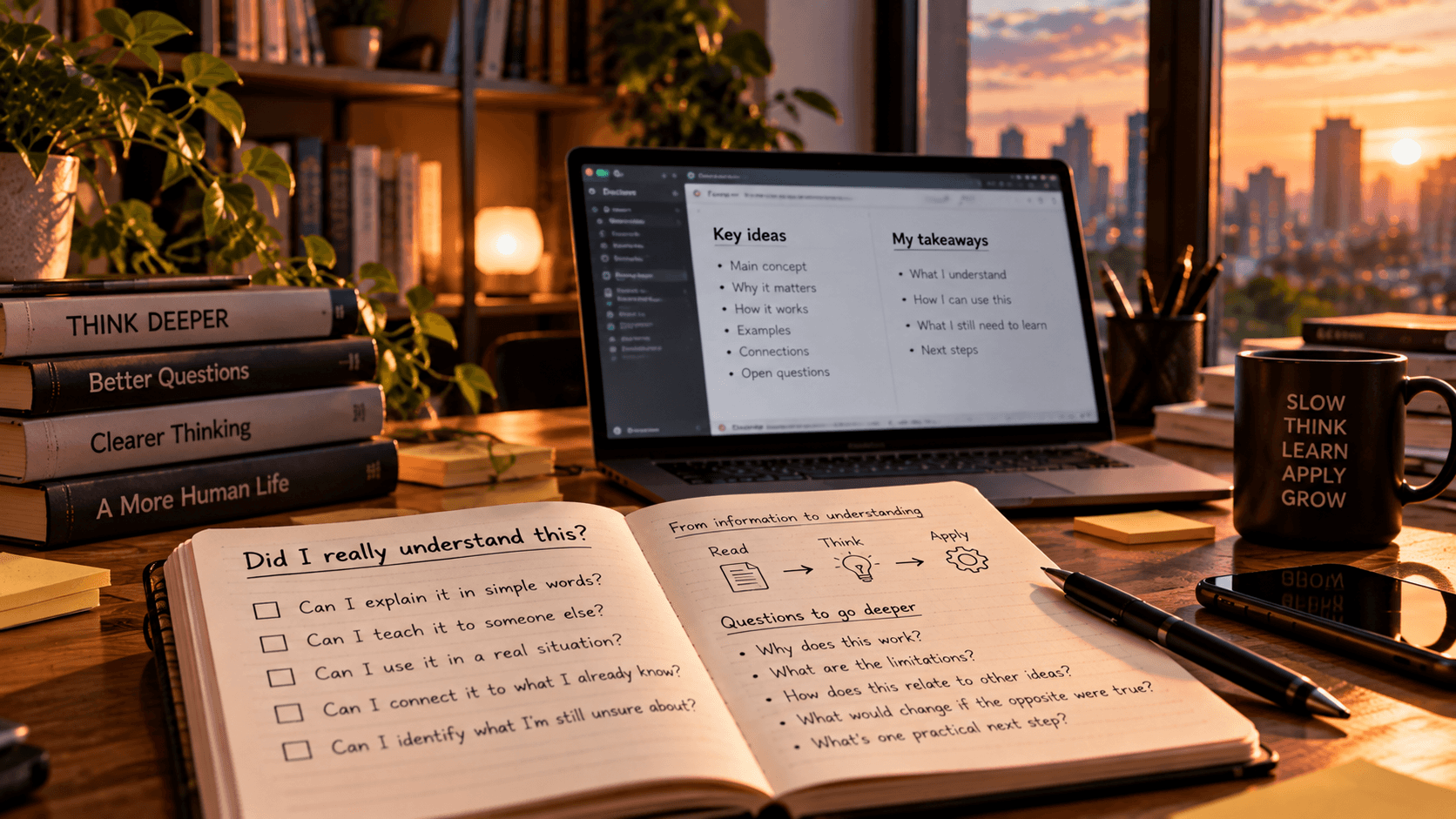
How to Know Whether You Actually Understand Something
Recognition can feel like understanding until you try to explain, apply or challenge an idea.

The Skill of Learning Before You Feel Ready
Waiting for complete readiness can delay learning. A better loop combines foundations, practice, feedback and adjustment.
Related books
João: An Ordinary Man, A Simple Life
A moving literary portrait of an ordinary man whose quiet choices, family bonds, work, and constancy reveal the extraordinary weight of a simple life.
What Remains: A Crossing Toward the Essence That Endures Time
A philosophical journey toward what remains when noise, roles, urgency, and the need for control begin to fall away.