How observatories synchronize measurements made in different locations
Atomic clocks, time stamps and correlation let distant radio telescopes behave as a coordinated scientific network.
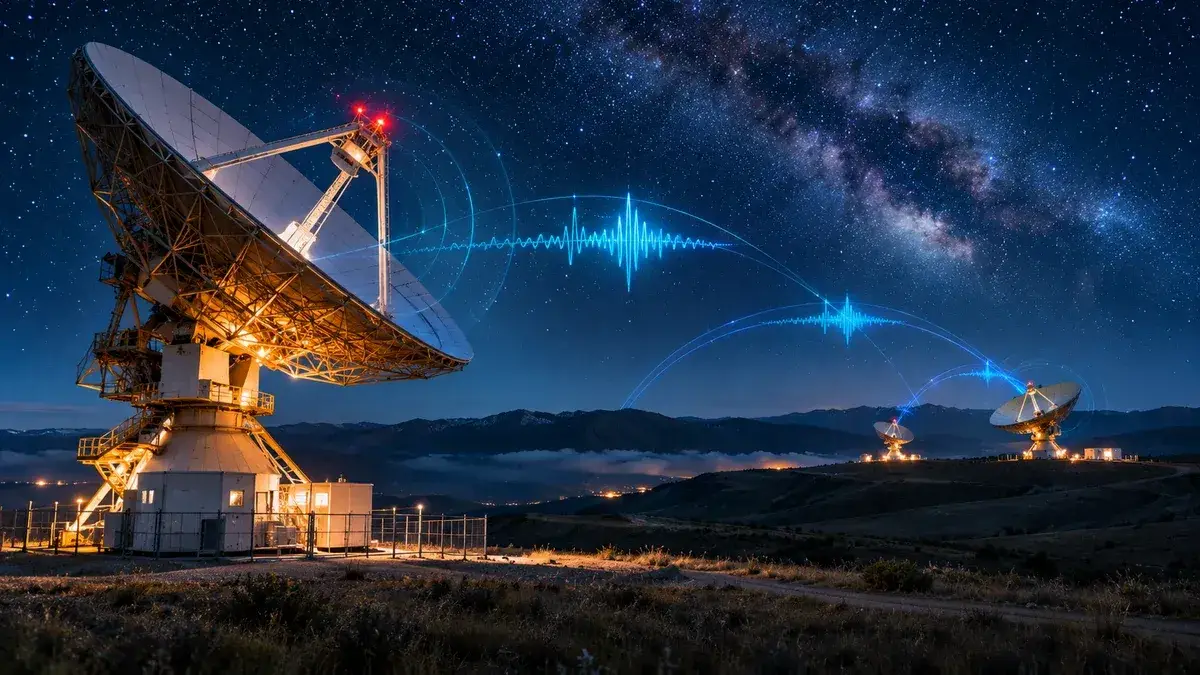
When two radio observatories point toward the same cosmic source, they do not receive its radio waves at precisely the same instant. A wavefront reaches each antenna at a slightly different moment because the stations occupy different positions on Earth. That tiny difference is valuable information: it can help astronomers combine observations across thousands of kilometers. To make use of it, however, researchers must know when each measurement was made and how their instruments behaved. It takes much more than synchronizing a computer clock to make that comparison scientifically meaningful.
Coordinating observations does not mean receiving identical signals
A quasar, a burst of radio emission or material near a black hole can be studied by antennas on different continents. Teams coordinate observing windows, target positions and frequency bands, while each station records its own stream of data. The purpose is not to force all signals to arrive simultaneously; it is to identify and model differences in arrival time and phase. For high-frequency work, even extremely small uncertainties can compromise the coherence of a combined observation.
The observing plan must also document antenna location, pointing, instrument settings and local electronics. Good time stamps without these measurements would be insufficient. Timing in astronomy is a combination of clocks, equipment calibration and physical modeling rather than one universal switch.
Stable atomic frequency standards make the records useful
Precision radio observatories may rely on extremely stable local frequency references, including hydrogen masers. Such standards help maintain timing consistency during long recording sessions. If clocks drift unpredictably, the data streams cannot be combined reliably. The Time and Frequency Division of the National Institute of Standards and Technology works on the metrology of stable time and frequency references, the foundation of precision measurements like these.
Coordinated Universal Time, or UTC, provides a common scale for scheduling and recording many operational events. Yet simply printing a UTC value on every file is not enough. Researchers still need to model differences between local clocks, the travel time through cables and electronics, and the geometric delay of a signal arriving from space. Precise metrology is about quantifying these differences, not assuming they have disappeared.
VLBI combines widely separated radio telescopes
Very long baseline interferometry, or VLBI, is a technique in which distant antennas record radio waves from the same source and researchers combine those observations. The separation between antennas provides an interferometric baseline. Useful long baselines, careful calibration and adequate signal quality can yield remarkably fine angular resolution.
The stations do not need to be connected like pieces of a single gigantic physical dish. Each collects observations independently. Later, large processing facilities align the recorded streams and search for measurable correlations. The technique can probe details that a single small radio telescope could not resolve alone.
Correlation connects separate recordings
A correlator examines data from different stations after applying expected differences in arrival time. The relevant models take into account station positions, Earth rotation and the finite speed of light, among other effects. Electronic delays and clock behavior are also estimated. Only then can computers look for coherent features across large datasets.
The Event Horizon Telescope is a widely known illustration of this international process. Stations recorded observations during carefully planned campaigns, and the data were brought to specialized facilities for correlation and analysis. The resulting black-hole images were scientifically reconstructed from interferometric measurements, not captured as a conventional single-camera photograph.
Navigation satellites are helpful but not a complete solution
Global navigation satellite systems can help reference clocks and compare time across locations. Such timing services also support telecommunications and other infrastructures. They do not automatically provide every frequency-stability or calibration requirement of an advanced radio experiment. Observatories often need local high-performance standards and independent measurement of instrumental delays.
A faulty receiver, changed cable length or unexpected electronics configuration may introduce a systematic error. Teams therefore check clocks, calibration signals and metadata throughout an observing campaign. Reliable science requires independent ways to detect drift rather than trusting a single displayed time.
A correct time stamp does not guarantee a correct measurement
The recorded time is only one piece of evidence. Radio-frequency interference, atmospheric effects, instrument noise and calibration errors can still distort the signal. Scientists use reference sources, uncertainty budgets and cross-checks between observing sessions to determine which results are robust. It is important to distinguish clock resolution, long-term stability and accuracy of the scientific estimate.
The same source is not expected to produce exactly the same raw signal at every station. Differences caused by geometry are precisely what makes interferometry informative. A good analysis preserves meaningful differences while correcting those introduced by known instrumental and propagation effects.
An international network is also a coordination system
A modern observation brings together astronomers, engineers, geodesists, data specialists and metrologists. Before a campaign, teams agree on scheduling and settings. During it, they monitor instruments and collect large quantities of data. Afterward, they transfer recordings, process correlations and document uncertainties so that other researchers can evaluate the conclusions.
The broader lesson applies to many distributed scientific systems: measurements become comparable when their references, timing, context and uncertainties are documented. Synchronization is not about pretending all instruments are perfect. It is about knowing their limitations well enough to combine data responsibly.
Frequently asked questions
Do observatories have to operate in the same time zone?
No. Civil time zones do not determine synchronization; compatible time references and accurate metadata do.
Is an internet connection enough?
No. Network connectivity helps with coordination and transfer, but precision observations also need stable clocks, calibration and physical models.
Does VLBI only measure signal arrival time?
No. Delay and phase information can be used to study astronomical structures and positions at high angular resolution.