How to imagine different futures without impossible predictions
Imagining tomorrow is not naming an inevitable date
When people ask what the world will look like in twenty years, an answer often arrives as a confident prediction: one technology will dominate, an occupation will vanish, or every city will follow a certain model. Yet the future has not happened, and human choices can change its direction. UNESCO explores futures literacy, the ability to understand how images of tomorrow shape the way we interpret today. The aim is not to produce one accurate photograph of events that have not occurred. It is to uncover assumptions, question expectations, and expand alternatives before making decisions with long-lasting consequences.
Distinguish forecasts, possibilities, and preferences
A forecast estimates what may occur under specified conditions, sometimes using data and statistical models. A scenario explores how a situation could develop without claiming to describe an unavoidable outcome. A preferred vision explains what people would like to create. Confusing these tools can turn personal preferences into apparent scientific facts or make conditional projections sound certain. The OECD describes strategic foresight as the structured exploration of plausible futures to prepare decisions in the present, not an exercise in selecting one predetermined winning story. Before beginning a conversation, ask whether each claim is an observation, a modeled projection, a possibility, or a goal.
Ground imagination in evidence from the present
Creative thinking does not require abandoning reality. Gather reliable evidence about observable developments in demographics, infrastructure, employment, technology, and natural resources. Then investigate the limits of the data, regional differences, and behaviors that could interrupt current trajectories. A striking news headline does not automatically demonstrate a structural trend. It also helps to distinguish a weak emerging signal, which may still be highly uncertain, from a pattern supported by repeated measurements. Strategic foresight uses horizon scanning and trend analysis to broaden the evidence base before developing scenarios. These methods reduce the risk of building a future story from enthusiasm or fear alone.
Build several coherent scenarios rather than prophecies
Choose a specific question, such as the future of travel within a city. In one scenario, public transport becomes more efficient while the urban layout changes gradually. In another, decentralized work reduces some commuting. In a third, severe climate pressures shift investment toward resilient infrastructure and new mobility priorities. You do not need to assign invented percentages to make these alternatives valuable. Explain which conditions would lead to each path and who could benefit or lose. An OECD guide describes scenarios as intentionally fictional alternative futures designed for dialogue, learning, and present-day action rather than predictions about what must happen.
Challenge the assumptions that feel obvious
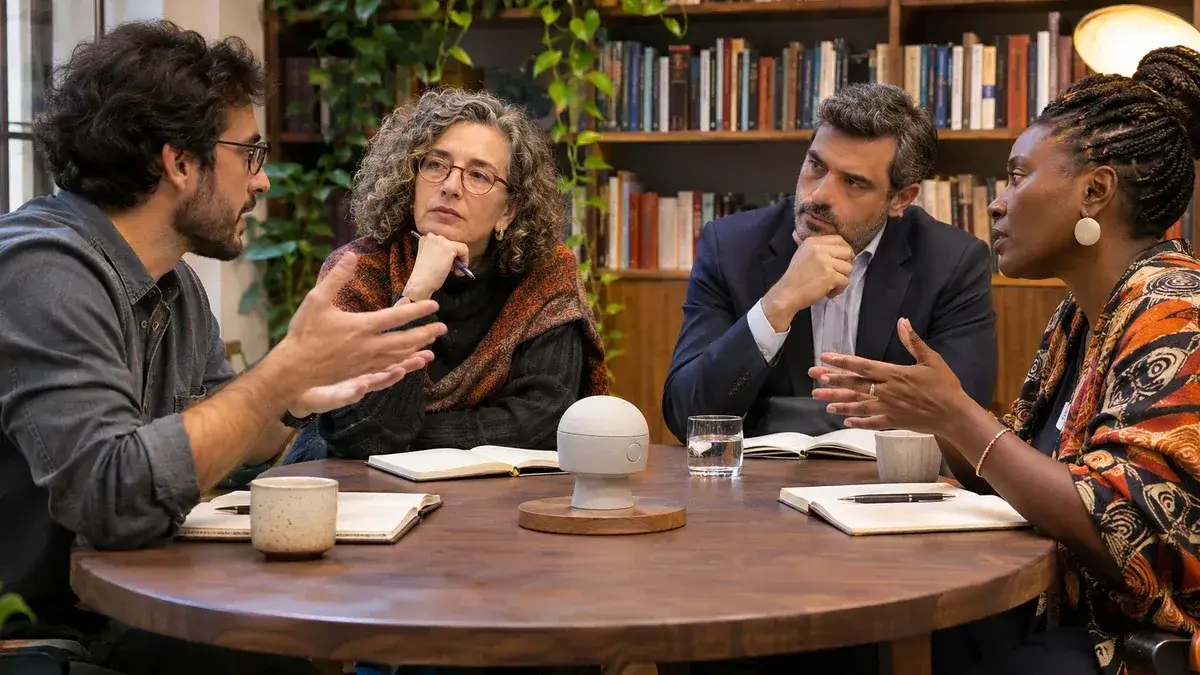
A productive exercise is to name three assumptions behind each scenario. Perhaps the story assumes that internet access will remain affordable, most jobs can be performed remotely, or governments will have enough resources to rebuild infrastructure. What changes if one of those assumptions fails? Such questions shift attention away from what we already expect and toward possibilities we have neglected. People of different ages, professions, and geographic backgrounds may identify very different outcomes. That is why participatory foresight exercises are richer when diverse perspectives are included and disagreement is treated as a source of insight rather than an obstacle.
Convert scenarios into adaptable decisions
Exploring alternatives should lead to something more useful than an attractive presentation. Ask which decisions remain sensible under several scenarios and which depend on one fragile assumption. A municipality might improve accessible sidewalks because they benefit many transport models. A company might develop transferable skills rather than putting all its resources into a single software product. OECD and UNDP foresight approaches emphasize testing strategies against several plausible conditions. This cannot eliminate uncertainty, but it can expose plans that would require rapid revision if circumstances develop in an unexpected direction.
Keep evidence, monitoring, and revision visible
A scenario is a temporary working tool. Identify observable signals that would indicate whether its underlying assumptions are becoming more or less credible. Record the discussion date, evidence sources, participants, and ideas that were not tested. Update scenarios as relevant information appears instead of preserving one because it sounds impressive. Avoid language that makes social, economic, or political choices appear inevitable. The value of responsible imagination lies in making room for alternatives, particularly when consequences will be shared by people who did not participate in the original decision.
A practical exercise for any team
Write one question about 2035, list five verifiable facts about the present, and identify two major uncertainties. Cross the uncertainties to outline four distinct scenarios, each with risks and opportunities. Invite people with different experiences to challenge the assumptions. Next, choose one useful action for today, one decision that can wait, and one indicator to follow over time. Finish by separating evidence, hypotheses, and preferences. You will not have discovered the future, but you may better understand current choices and develop plans that do not depend entirely on one prediction turning out to be correct.
Frequently asked questions
Are forecasting and foresight identical?
No. Forecasting estimates outcomes under assumptions, while foresight explores alternatives to inform decisions under uncertainty.
Must a scenario be highly probable?
It should be coherent and useful for the question. Some exploratory scenarios do not carry assigned probabilities.
How do I avoid unsupported fantasy?
Separate observed facts from hypotheses, provide sources, and explain which changes each scenario would require.